Singing the Invisible Moon
An astrophysicist who lost her sight tracking satellites attempts to map a specific, transient orbit that no other telescope can see.
The air inside the dome smelled of ozone and old coffee, a sharp, metallic tang that clung to the back of the throat before the wind even howled outside. Dr. Elena Rostova sat at her console, the only light in the massive circular room coming from three rings of specialized glass that turned the pre-dawn sky a bruised, electric violet. She adjusted her barometer not to measure pressure, but to listen; the device hummed with a low, rhythmic vibration that matched the frequency of the satellites drifting overhead. Her fingers traced the brass dial as it pulsed, a steady thrum that matched the building's own structural groan. This was the moment she needed: not silence, but a specific kind of resonance where the instruments stopped measuring and started remembering.
"The moon is not silent; it is simply forgetting how to speak," the notes in her logbook read, written thirty minutes ago by a junior technician who had just emerged from the lower floor carrying a fresh cup of tea.
Elena didn't write anything else. She had lost her sight two years prior while tracking a failed transfer of deep-space telemetry, an accident that left her world reduced to the sharp click of her cane against the floor and the low hum of the ventilation fans. Before then, she could have seen the satellites as mere dots against the violet expanse, calculating their trajectories with geometric precision. Now, she relied on the hum of the dome and the subtle shifts in her own breath as beacons. Her task was to map an orbit that no other telescope could see, a transient path of a rogue satellite that appeared only for the briefest flicker of time before vanishing into the deeper dark.
The sound of the wind against the specialized glass was a constant, sharp hiss, like rain on a tin roof. Elena closed her eyes and focused on the hum of the barometer, counting the beats. One, two, three. The rhythm was irregular, a stutter in the pattern she had built over years of quiet observation. She tapped her cane against the floor, a percussive rhythm that synchronized with the barometer's pulse. As she counted, the vibration shifted slightly—a fraction of a second earlier than before. It was this tiny deviation that signaled data, not noise.
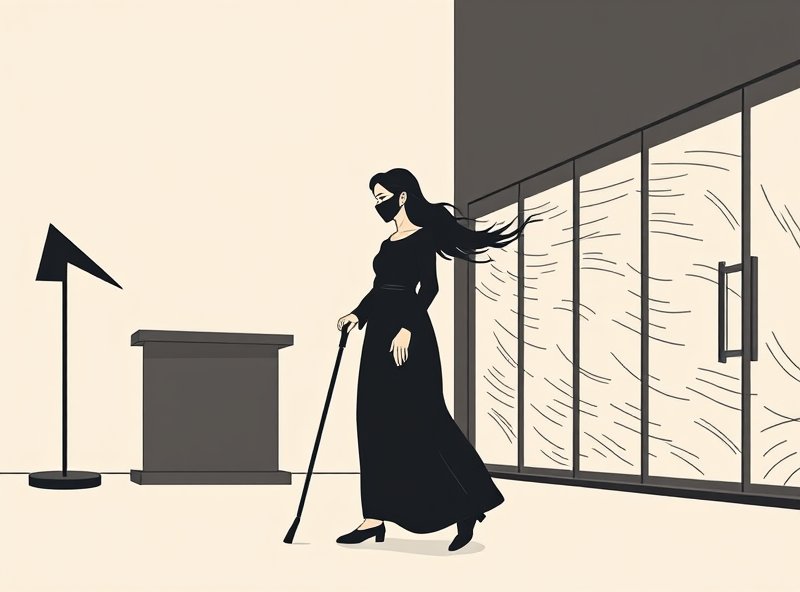
A moment later, the door to her office creaked open. Julian, the lead engineer, stood there holding a printout from last week's satellite scan. He adjusted his glasses and looked directly at her, though he couldn't see her face clearly beyond the shadow of her mask.
"Look here," Julian said, pointing to a jagged line on the paper with his pen. "This is where your signal dropped. We missed it because we were all staring at the same purple frame."
Elena shifted her posture, leaning forward until her ears pressed against the microphone array. "The violet frame hides the jump," she said softly, reciting the calculation aloud so the sound waves of her own voice would trigger the next sensor. "If I modulate the frequency to match the wind, we can isolate the transient event."
She tapped her earpiece, sending a command into the global network. Within seconds, three remote telescopes across the continent synchronized their exposure time to her exact millisecond calculation. The hum of the observatory dome rose in pitch, sharper and clearer than before, as if the entire structure leaned toward the sound. A new frequency emerged from their instruments—a clear, high-pitched ring that stood out against the low thrum of the structure itself.
Elena exhaled, her breath fogging the inside of the glass panels until it shimmered faintly against that electric violet backdrop. "That was the invisible moon," she whispered, the word carrying into the silence of the room and back again without fading. "It's been orbiting us all along, just waiting for us to stop looking at the picture and start hearing the echo."
Julian nodded slowly, then pulled out his phone. "Got it recorded on all the systems. Want me to save this sequence?"
"Yes," Elena replied, and for the first time since the accident, she smiled—not because she could see what she had found, but because the universe had finally responded to her voice.