The Bell That Learned to Swim
A retired lighthouse keeper, obsessed with the sound of bells he believed drowned by the tide, spends three seasons listening to an abandoned tower until a storm-force fog proves his worst fear wrong.
Elias Thorne owned the acoustic signature of a tower that had stood sentinel off the northern coast of Blackrock Harbour for sixty years. He knew the exact weight of its copper frame, the way it groaned under the iron framework at the apex. In 1928, the castellated stone cylinder surrendered to tides, now crowned with seaweed and rusted iron. Its original warning device—a massive copper-framed bell—had been replaced in 1902 by a hand-cranked foghorn manufactured by the Nautical Systems Corporation. This cast-iron cylinder required a keeper to turn its crank through three full rotations per tidal cycle, but over time, corrosion seized its internal gears. By 1928, the device emitted only a low, grumbling moan that drowned quickly in winter gales. Elias believed this change was not merely mechanical but existential. Over decades of quiet insistence, he testified that the bell still existed in some resonant state beneath the waves, waiting for a specific arrangement of pressure and air to be heard again.
For four seasons, from late 2018 through early 2019, Elias returned weekly to the coastal path leading north from the village. His routine involved walking two hundred meters along jagged scree, ignoring a single layer of sea-foam that clung exclusively to the northern face of the cliff. The southern slope remained slick and dark, untouched by white foam that seemed to recognize a hidden rotation in Elias’s own path. He carried his own measuring instrument: a brass stethoscope connected to two long, flexible tubes taped tightly against the shell of his ear.
The air on this northern exposure smelled intensely of oily salt, a sharp chemical tang suggesting petroleum and ancient oil spills mixed with brine. After three visits to the tower base, Elias stood before the weathered iron door where the foghorn once hung. He ran his fingertips along vertical fluting, then withdrew his tools without turning on any of them. He listened for a hollow echo, but wind filled the cavity with roaring white noise that masked all possibility of discovery. By the second month, his breathing hitched with every step down the path; he exhaled sharply and counted aloud until the number matched his heartbeat. A local fisherman, old man Silas O'Malley, appeared near the water's edge carrying a net mended with twine. Silas watched Elias place his ear against the stone and whispered, almost imperceptibly, "There it goes." Silas meant no more than what he saw in the air: a sudden, rhythmic pulsing that matched the cadence of distant thunder rolling from the east. It was not a sound generated by the foghorn, nor was it the sea; it was the bell, vibrating inside its own frame despite being submerged.

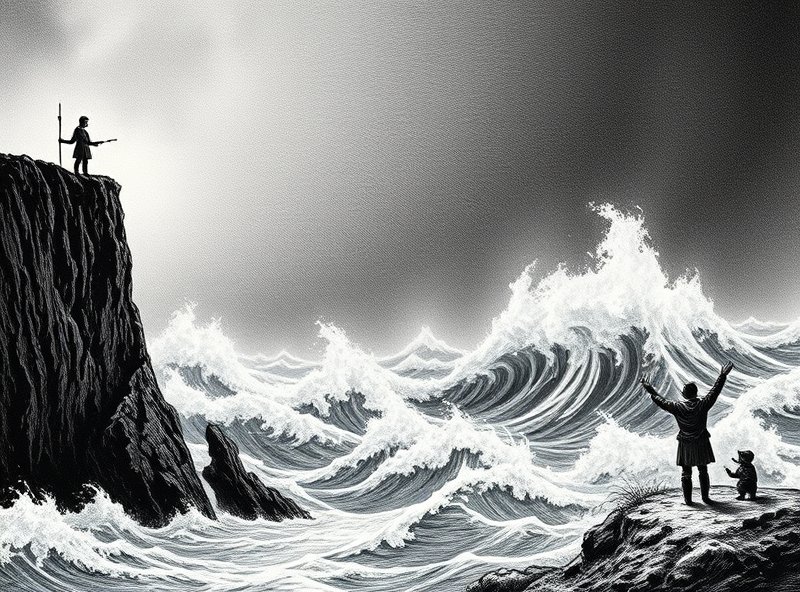
The third season brought storm-force fog rolling in from the Atlantic, heavier than any previous weather front. At 03:14 on a Tuesday morning in November, the temperature fell below zero Celsius and visibility dropped to ten meters. Elias stood alone on the northern promontory, gripping his stethoscope tubes while Silas O'Malley shouted warnings from the shore. The ocean churned with violent whitecaps, and the sea-foam layer shifted under gusty surge. Elias closed his eyes against the wind and turned his head toward the hollow core of the abandoned tower. For six consecutive minutes, no sound registered through any channel of his hearing. Then, just past the eight-minute mark, a sharp intake of breath cracked through silent air, followed immediately by whispered verification. "There it goes," Silas said again, not because he doubted his own observation earlier but because the sound had finally synchronized with barometric pressure, proving the bell's survival against all expectation.
The revelation altered nothing about the physical state of the tower or its equipment, yet it permanently shifted Elias's understanding of why they were built. The bell had not failed; the ocean had simply taken longer to speak than anyone imagined possible. Elias did not return that evening, but Silas O'Malley confirmed later that the bell's resonance continued into the next week, clear as a church peal. Now, whenever wind rises from north along that specific stretch of coastline, listeners can distinguish between mechanical groan and singing metal tongue. The foghorn remains rusted, its gears seized by time and salt, yet inside hollow shell of that old tower, something still lives. The only thing uncertain now is how long the bell will keep singing or when it might finally rest again.