The Shadow of the Salt Mine
An ex-miner, now blind, feels for a single loose stone in the cavern he once crushed to death.
Elias Kowalski squeezed his eyes shut. He did not want to block out the darkness; he wanted to feel the rough limestone walls with his fingertips. Blind for three years after a collapsed retinal artery shattered his vision, he knew the mine's geometry better than any sighted man. He did not walk; he moved by touch, his fingers trailing along the rough-hewn perimeter of a single access tunnel in the abandoned salt cavern. His hands were calloused, reading the subtle variations in temperature and texture that his eyes could no longer provide. Here, the air tasted of brine and ancient dust, heavy with the memory of men who had crushed billions of tonnes of salt into the earth before leaving their picks behind.
The first object he encountered was a pickaxe, bent out of shape and half-buried in the silt floor. It belonged to Tomas Vrtiček, a foreman who had worked there for twenty years before the roof gave way on November 14, though no one could say exactly where he fell or whether he survived the initial impact. Elias reached out and felt the rusted metal, cold against his palm after decades of neglect. He groaned softly, rotating the tool until it found a purchase in his mind, visualizing the arc of Tomas's arm as he swung down to break another vein.
Then came the sound, a quiet but relentless rhythm: water dripping from a ceiling tunnel that had collapsed years ago. It created a ticking sound, steady as a metronome keeping time for the unseen shifts of subsurface pressure. *Tic. Tic. Tic.* Each drop echoed into the hollow throat of the cavern, bouncing off layers of salt and shadow. Elias counted them aloud, not merely to track time but to measure the distance between himself and death's thin edge. By his calculation, about forty-seven beats separated him from the main shaft where Tomas might still be trapped beneath the debris.
He began to whisper, his voice trembling slightly as he spoke the name of his young son, Marko. "Where did you end up inside the rock?" he asked, imagining his boy buried among the broken strata. He pictured Marko not as a child but as part of this vast, salt-filled landscape—perhaps wedged against the wall where the tunnel once ran, or crushed in a moment of sudden collapse. The question hovered in the silence, sharp and precise, demanding an answer from a place that rarely replied. Elias paused, listening to the dripping water tally his progress.
As he continued scanning the ground, Elias felt a small irregularity beneath his left boot—a loose stone that had shifted since he last passed this spot. He shifted his weight and pressed down, feeling its irregular shape under his shoe before kneeling to dig it free. With careful fingers, he brushed away the silt and pulled the fragment loose. It was a shard of blackened granite, jagged and sharp, about the size of his thumb, bearing traces of mica glittering faintly in the dim light filtering from a distant crack.
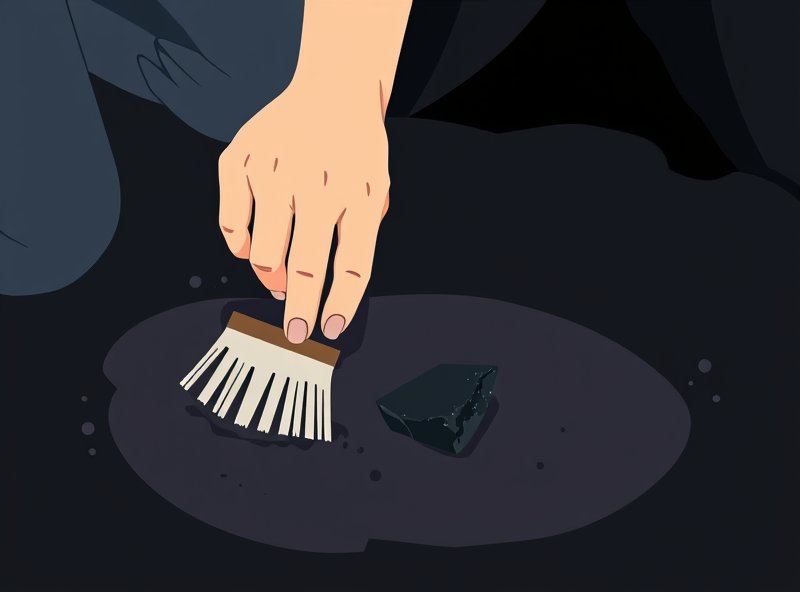
This fragment was significant, though why felt unclear at first glance. For years, Elias had believed the mine was hollow, mostly empty space waiting to be filled by new projects or forgotten memories. But this stone suggested otherwise—that something had once fallen, shifted, and settled again. Perhaps it was a fragment of the roof that gave way in 1974, when Tomas Vrtiček went missing or disappeared entirely into the depths.
Elias ran his thumb over the granite once more, careful not to scrape away any detail. "You're still here," he whispered to himself and to Tomas, imagining both in the same breath. "Marko is here too." And maybe they were all still connected, bound together by the silent conversation of those who came before and those like him who kept moving forward.
He straightened up, brushing dirt off his trousers, and held the stone in his palm. It was heavier than expected, yet carried no answers—only a presence, tangible and undeniable. The dripping water stopped its rhythmic ticking for a brief moment, replaced by the sound of his own breathing. That pause felt intentional, as though the cavern itself was exhaling, acknowledging him.
Then, he turned back toward the entrance, carrying not just a stone but a story—a new version of what lay beneath his feet. The mine wasn't so much empty as it was full, crowded with history and possibility, waiting for someone to ask again.